
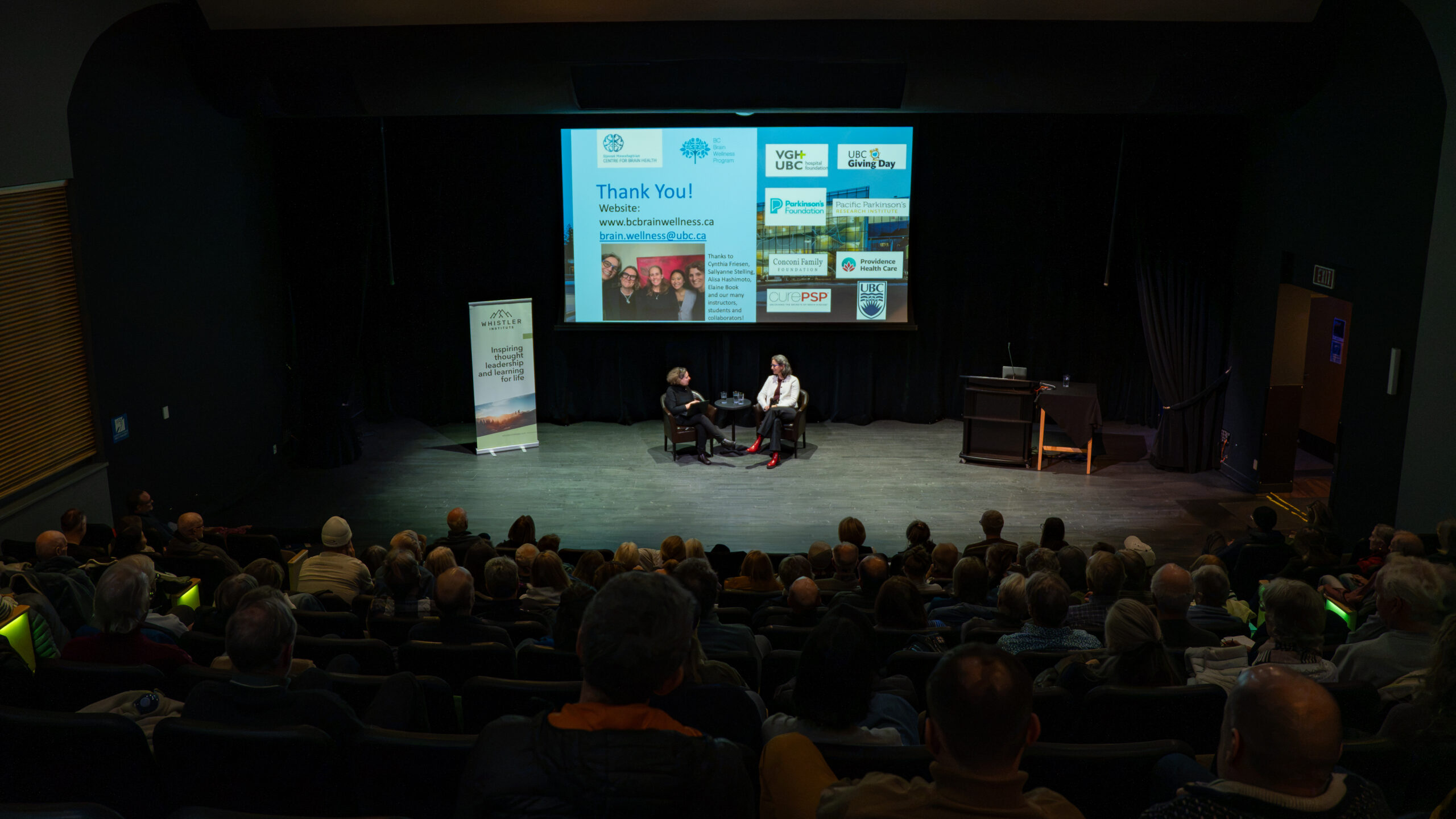
On November 18, the Whistler Institute welcomed Dr. Silke Appel-Cresswell and Dr. Judy Illes to the Maury Young Arts Centre for Brain Health, the third event in our 2026–2027 Global Perspectives Speaker Series.
With more than 100 people in attendance, the evening invited us to explore an important question: What can we do today to support a healthier brain tomorrow?
Building on October’s conversation about the science of healthy aging, Dr. Appel-Cresswell turned our attention to the body’s most complex organ, exploring what emerging research reveals about brain health and the role we can play in protecting and supporting our brains throughout our lives.
The result was an empowering conversation about the relationship between science, everyday choices and our collective ability to create communities that support lifelong brain health.
The Speaker & Moderator
Dr. Silke Appel-Cresswell
Dr. Silke Appel-Cresswell is a movement disorder neurologist, researcher and Associate Professor of Neurology at the University of British Columbia, affiliated with the Djavad Mowafaghian Centre for Brain Health.
Her work explores the mechanisms underlying neurological disorders and the relationship between lifestyle, environmental factors and brain health.
Through the lens of neuroscience and clinical research, Dr. Appel-Cresswell encouraged us to think about brain health not simply in terms of disease and treatment, but as something we can actively support throughout our lives.
Dr. Judy Illes
Dr. Judy Illes is a Professor of Neurology at the University of British Columbia and an internationally recognized scholar in neuroethics. Her work examines the ethical, social and policy implications of advances in neuroscience.
As moderator, Dr. Illes helped connect the science with broader questions about individual and collective responsibility, guiding both the conversation and audience Q&A.
What was discussed:
Throughout the presentation, moderated conversation and audience Q&A, the evening explored a number of interconnected themes:
Brain health across the lifespan — recognizing brain health as something that deserves our attention at every stage of life, rather than only when symptoms or concerns arise.
The role of physical activity — exploring the relationship between movement, exercise and brain function, and the importance of staying active throughout our lives.
Nutrition and brain health — considering how our everyday dietary choices can influence brain function and long-term neurological health.
The importance of sleep — understanding the role of quality sleep in supporting brain function and overall well-being.
Social connection and well-being — recognizing the importance of meaningful relationships, social engagement and staying connected to our communities.
Moving from reactive to proactive care — shifting our thinking towards prevention, risk reduction and the opportunities we have to support our brains before challenges arise.
Supporting brain health as a community — considering how our shared environments, resources and opportunities can make healthy choices more accessible and sustainable.
Perhaps one of the most empowering takeaways from the evening was the degree of agency we have when it comes to supporting our own brain health. While not all factors that influence neurological health are within our control, the choices we make around movement, nutrition, sleep and social connection can make a meaningful difference.
This leaves us with a broader question: How can we work together as a community to make those healthy habits easier to build and sustain?
Continuing the Conversation
Brain Health was designed not only to share current research and scientific perspectives, but also to encourage us to reflect on how that knowledge might inform our everyday lives and the communities we build.
In Whistler, where we have access to remarkable natural environments, opportunities for physical activity and a wide range of community resources, there is an opportunity to consider how we can better leverage these strengths to support brain health across generations.
We are grateful to the Whistler Health Care Foundation, our Event Sponsor, for helping make this presentation possible, and to Whistler Mature Action Community (MAC), our Community Partner, for helping connect this broader conversation with the resources, experiences and needs of our local community.
This event marked the conclusion of our fall 2026 Global Perspectives Speaker Series. We look forward to returning in 2027 with more ideas worth exploring and conversations worth having.
Stay connected through our newsletter and social media channels to find out what’s next.
Watch the Recording:
This event was sponsored by

And in community partnership with
