
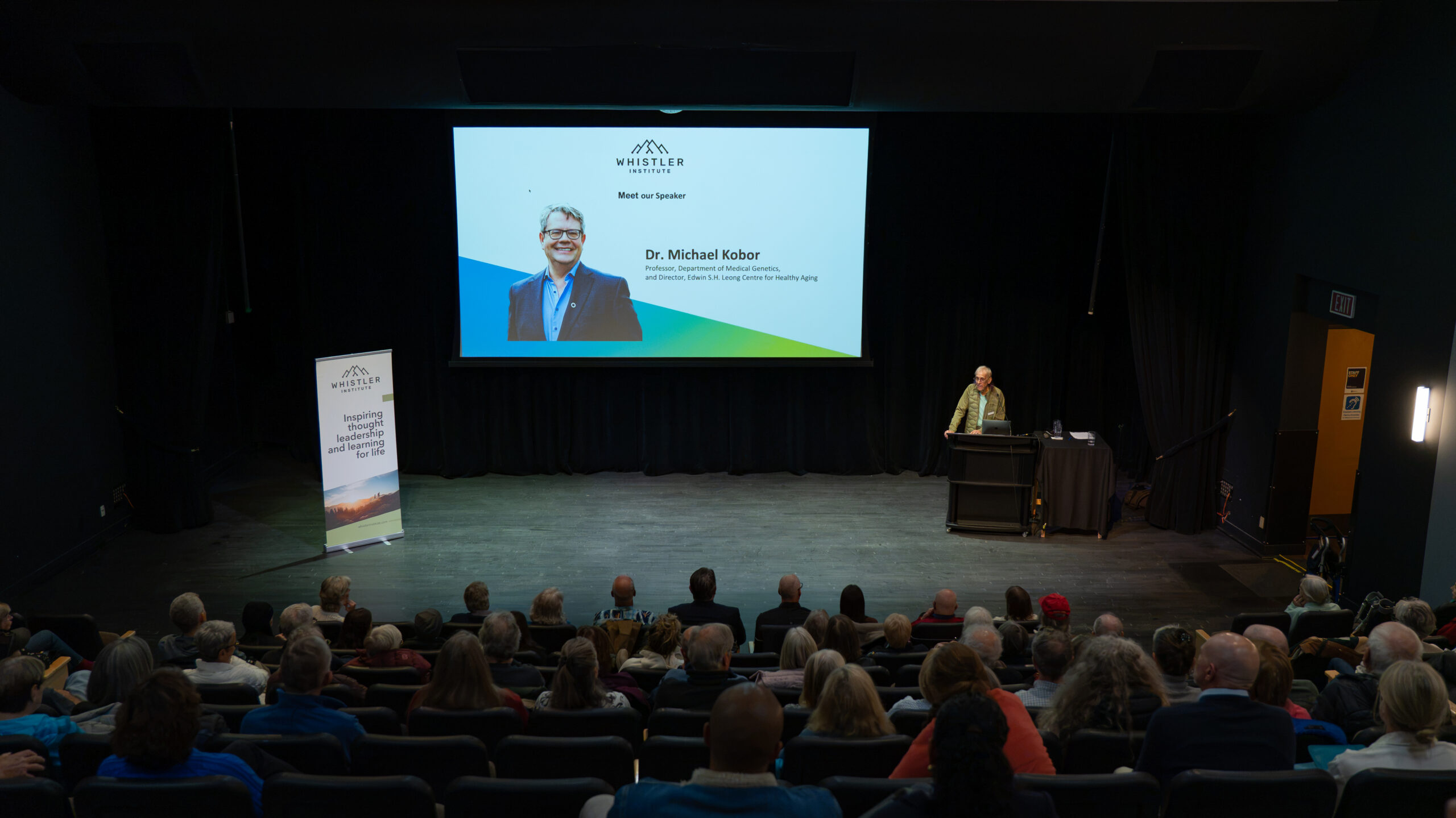
On October 14, the Whistler Institute welcomed Dr. Michael Kobor to the Maury Young Arts Centre for Aging in the Right Place, the second event in our 2026–2027 Global Perspectives Speaker Series.
The evening invited us to rethink a seemingly simple question: What does it really mean to age well?
While chronological age tells us how many years we have lived, Dr. Kobor introduced the audience to the emerging science of biological aging and epigenetics—exploring how our biology reflects not only our genetics, but also the environments, experiences and social conditions we encounter throughout our lives.
The result was a fascinating look at aging through a life-course lens: from the biological traces of our earliest experiences to the choices, relationships and environments that continue to shape our health as we grow older.
The Speaker
Dr. Michael Kobor is a Professor in the Department of Medical Genetics at the University of British Columbia, Research Chair in Social Epigenetics, and Director of the Edwin S.H. Leong Centre for Healthy Aging.
His work examines the relationship between our social and physical environments and our biology, helping researchers better understand how experiences can become biologically embedded and influence health across the lifespan.
Through the lens of epigenetics, Dr. Kobor challenged us to think about aging not simply as something that happens later in life, but as a process shaped across our entire life course.
What was discussed:
Throughout the presentation and audience Q&A, Dr. Kobor explored a number of interconnected ideas:
Chronological age versus biological age — why the number on our birth certificate tells only part of the story, and how researchers are developing tools such as epigenetic clocks to better understand the biological aging process.
Nature, nurture and epigenetics — how our genes interact with our environments and experiences, and how epigenetics provides a window into that relationship.
The lasting influence of early life — how factors experienced early in life, including social and environmental conditions, can leave biological signatures that may influence health years or even decades later.
Aging across the life course — shifting our thinking about healthy aging from something we address only later in life to something influenced by experiences and conditions throughout our lives.
The factors that shape healthy aging — including nutrition, physical activity, social connection, socioeconomic conditions and our broader environments.
The evolving science of healthy aging — and the importance of interdisciplinary research in helping us better understand not simply how to live longer, but how to extend the years we live in good health.
Perhaps one of the most important takeaways from the evening was that there is no single switch we can flip to determine how well we age. Instead, healthy aging reflects a complex interaction between our biology, our experiences, the choices available to us and the environments and communities in which we live.
Continuing the Conversation
Aging in the Right Place was designed not only to share emerging research, but also to encourage a broader community conversation about what it means to live—and age—well.
That conversation continued after the formal presentation, as attendees stayed to connect, ask questions and reflect on the ideas raised throughout the evening.
We are grateful to Beedie Living, our Event Sponsor, for helping make this presentation possible, and to Whistler Mature Action Community (MAC), our Community Partner, for helping us connect this global research with conversations and experiences here in Whistler.
Our exploration of healthy aging continues on November 18 with Brain Health, featuring neurologist and researcher Dr. Silke Appel Cresswell, moderated by neuroethics scholar Dr. Judy Illes.
Together, we’ll turn our attention to the brain and explore what emerging research can teach us about supporting brain health throughout our lives.
Continue Exploring
For those interested in digging deeper into some of the research and ideas shared during the evening, Dr. Kobor provided several resources:
AgingWellBC — research-informed information and practical guidance for older adults, caregivers and communities.
What is Geroscience? — an introduction to the science connecting biological aging, health and age-related disease.
Edwin S.H. Leong Centre for Healthy Aging at UBC — learn more about the Centre’s research, researchers and upcoming events.
Why Eating Protein Matters for Your Muscles—Especially if You Aim to Age Well — featuring Dr. James McKendry on nutrition, muscle health and healthy aging.
NEST Lab — Dr. Julie Robillard’s research exploring technology and brain health across the lifespan.
Watch the Recording:
This event was sponsored by

And in community partnership with
